
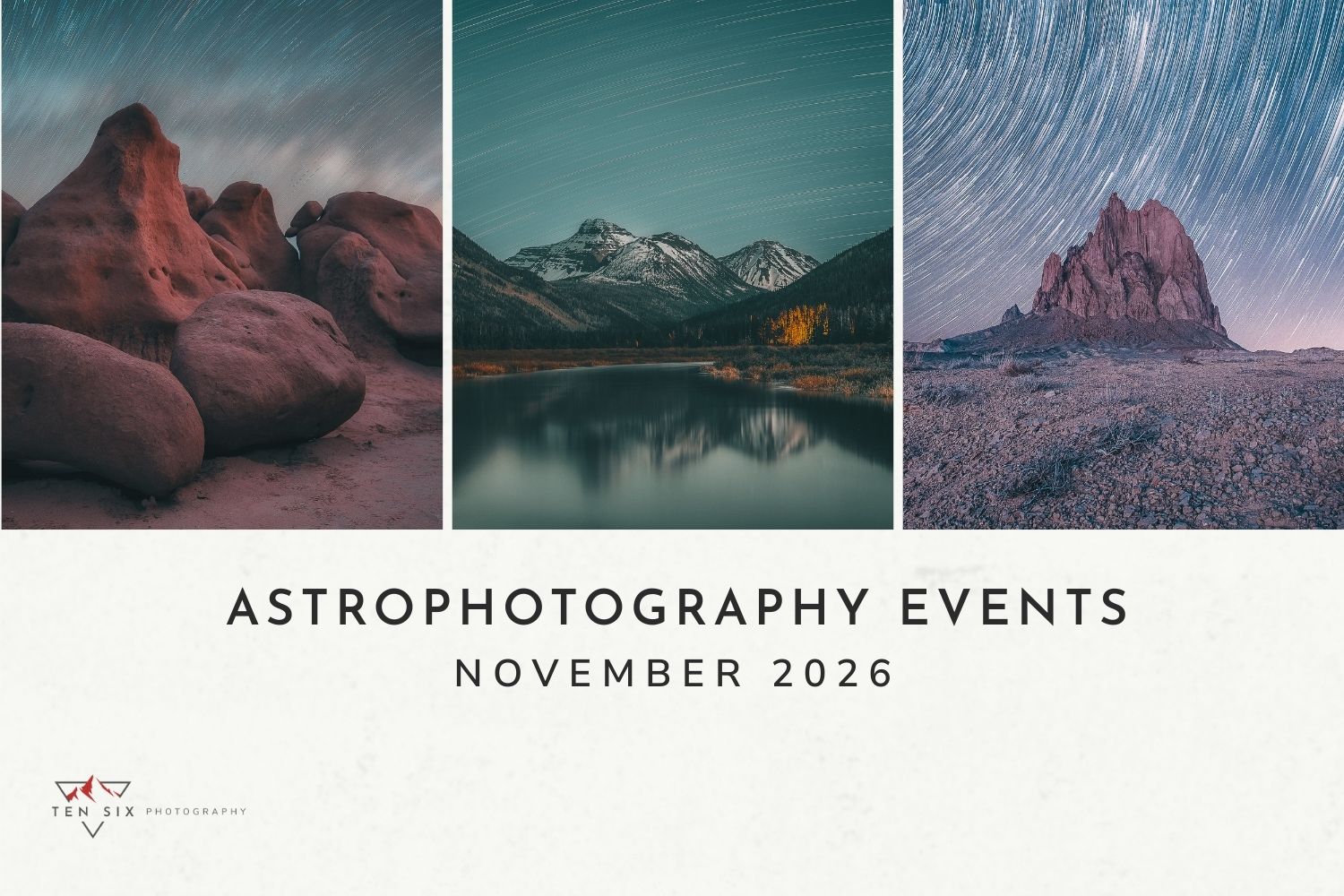
November is where astrophotography becomes quieter, and sharper.
The long summer nights are gone. The Milky Way coreThe densest and brightest region of the Milky Way galaxy, visible as a central bulge of stars and dust clouds. is no longer the draw. In its place are colder air, steadier skies, and a calendar that rewards photographers who choose carefully and commit fully to a handful of nights.
If October was the pivot, November is the refinement. This is not a month for chasing everything on the calendar. It’s a month for picking targets that align with the season: bright planetary pairings, intentional meteor attempts, and clean night landscapes under dark skies.
Key Events for November 2026
Nov 9 | New Moon
Event Type: New MoonThe lunar phase when the Moon is positioned between Earth and the Sun, making it invisible from Earth.
Visibility: Excellent
Difficulty: Easy
November’s New Moon opens a clean, quiet dark-sky window.
Milky Way core season is largely behind us, but night landscapes, fall constellations, and early winter star fields are very much in play. This is a night for clarityAn adjustment in photo editing that enhances midtone contrast, improving the texture and details in an image., structure, and restraint.
Lean into foreground storytelling and clean sky separation rather than trying to force summer-style images.
Viewing Tips:
Pro Tip: Late-season dark skies favor simplicity over drama.
Nov 12 | Northern Taurid Meteor Shower (Peak)
Event Type: Meteor ShowerA celestial event where multiple meteors radiate from a single point in the sky, typically caused by Earth passing through a comet’s debris.
Visibility: Good
Difficulty: Easy
The Northern Taurids complement the Southern branch, with continued fireball potential and similar shooting strategy.
Rates remain modest, but brighter events can still deliver standout frames, especially under darker skies earlier in the month.
Viewing Tips:
Pro Tip: Fireball nights are remembered, even if they only produce one keeper.
Nov 15 | Mars–Jupiter Conjunction
Event Type: ConjunctionThe apparent meeting or close approach of two celestial objects in the sky, such as planets or the Moon and a star.
Visibility: Excellent
Difficulty: Moderate
This is one of the year’s strongest planetary pairings.
Bright, close, and immediately readable, Mars and Jupiter offer both storytelling and compositional flexibility. You can shoot this wide with a landscape anchor or tighter to emphasize the pairing itself.
This is a rare case where both approaches work.
Viewing Tips:
Pro Tip: If a conjunction feels obvious, lean into it. Clean beats clever here.
Nov 17 | Leonid Meteor Shower (Peak)
Event Type: Meteor Shower
Visibility: Mixed
Difficulty: Moderate
The LeonidsA meteor shower occurring in mid-November, known for its fast-moving meteors. are fast and famous, but most years are modest.
With a First QuarterThe lunar phase where half of the Moon’s disk is illuminated, occurring about a week after the new Moon. Moon present, faint activity will be limited. This is a “shoot if you’re already out” event unless forecasts suggest enhanced rates.
Still, Leonids can surprise.
Viewing Tips:
Pro Tip: Leonids punish expectation. Go in neutral and you’ll enjoy them more.
Nov 24 | Full Moon (Beaver Moon)
Event Type: Full MoonThe lunar phase where the Moon appears fully illuminated from Earth’s perspective.
Visibility: Excellent
Difficulty: Easy
November’s Full Moon favors clean, deliberate moonrise and moonset compositions.
Late-fall landscapes pair well with long-lens compression, and cooler air often improves clarity near the horizon.
This is a night for planning and patience, not improvisation.
Viewing Tips:
Pro Tip: The best Full Moon frames usually happen early—be set up before it clears the horizon.
Nov 25 | Mars–Regulus Pairing
Event Type: Conjunction
Visibility: Excellent
Difficulty: Easy
This is a clean, minimal pairing that holds up even under full moonlight.
With background stars washed out, simplicity becomes an advantage. Mars and Regulus carry the frame without distraction.
Viewing Tips:
Pro Tip: When the sky is bright, less really is more.
How November Fits Into the Bigger Picture
November is the closing chapter of the active year.
It’s where habits solidify, where you see what styles and subjects you gravitated toward, and where winter planning begins to take shape. Photographers who rush November often feel scattered in December.
Those who slow down arrive clearer.
Tips for November's Events
November favors discipline.
Shorter sessions, colder temperatures, and fewer targets mean you can streamline your kit. Stable tripods, long lenses, and reliable batteries matter more than variety.
This is also a good month to evaluate what gear actually earned its place in your bag this year.
Wrapping Up November
November doesn’t ask for hustle.
It asks for restraint, patience, and attention. Choose a few nights. Commit to them fully. If you walk away with a small set of clean, intentional images—and a clear sense of what kind of photographer you were this year, November has done its job.


0 Comments